Cedar shake is the most naturally beautiful roofing material on the market - and one of the most misunderstood. "Cedar shake" gets used loosely to describe three genuinely different products: machine-cut cedar shingles, hand-split cedar shakes, and synthetic cedar shake. Each has its own price, lifespan, and fire rating, and the gap between them matters more than most homeowners realize before they buy.
What Is Cedar Shake, Really?
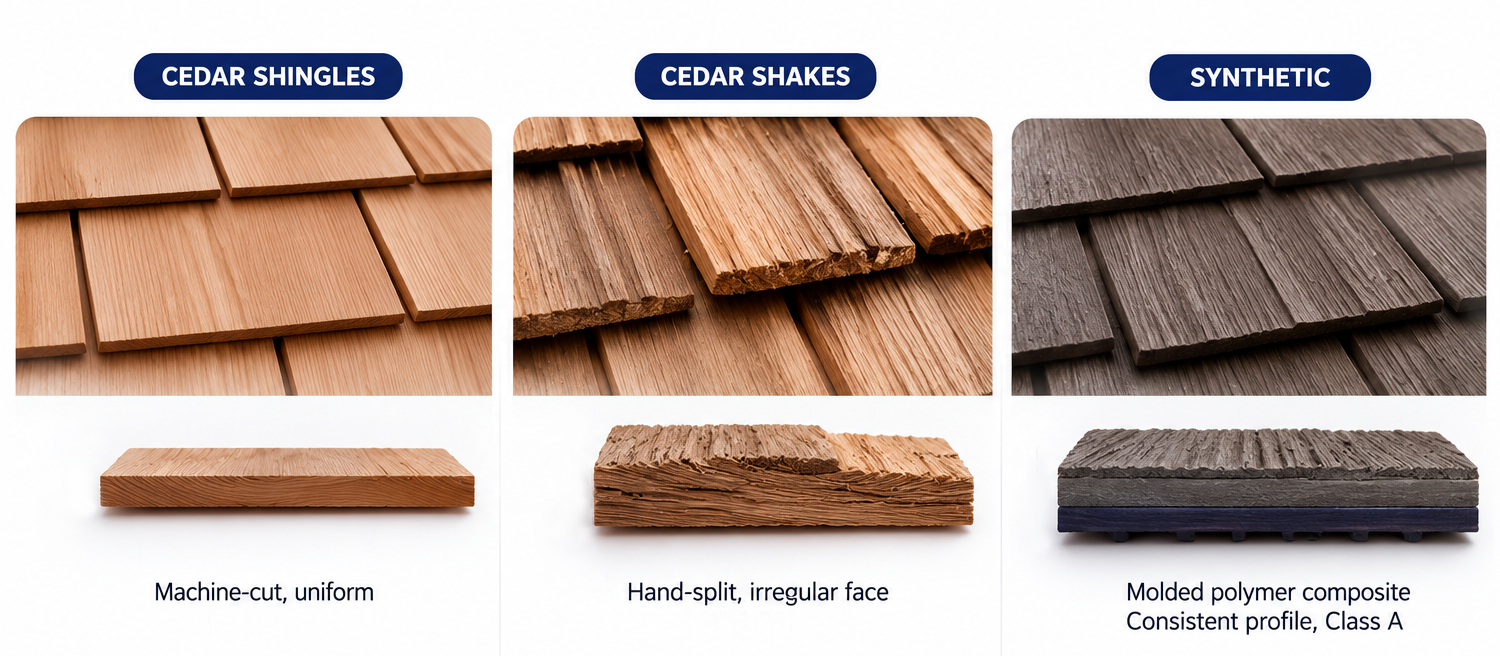
All three products start from Western Red Cedar or a synthetic replica of it, but the manufacturing process changes everything downstream. Cedar shingles are sawn by machine into thin, uniform pieces. Cedar shakes are hand-split or split-and-resawn from cedar blocks, leaving a thicker, irregular face with real texture. Synthetic cedar shake replicates that same irregular look using polymer composites or recycled rubber and plastic - no wood at all.
Cedar Profile Comparison - Where the Tiers Differ
Cedar Shingles (Machine-Cut)
Cedar shingles are sawn by machine into thin, smooth, uniform pieces - the most affordable way to get a real-wood roof. They read as tidier and more formal than shakes, closer to the look of a traditional New England roof than a rustic mountain cabin.
- Lifespan: 25-30 years maintained
- Fire rating: Class C untreated; B/A with treatment
- Look: smooth, uniform, formal wood texture
- Best for: homeowners who want real cedar at the lowest entry price
Cedar Shakes (Hand-Split)
Hand-split cedar shakes are thicker, heavier, and more irregular than shingles - split from cedar blocks rather than sawn, which leaves a rough, dimensional face that deepens the shadow lines across the whole roof. This is the classic "cedar shake" look most homeowners picture, and it's the default recommendation for most cedar roofing projects.
- Lifespan: 30-50 years maintained
- Fire rating: Class C untreated; B/A with treatment
- Look: thick, rustic, deep natural shadow lines
- Best for: homeowners who want the authentic cedar look and are ready for real maintenance
Synthetic Cedar Shake
Synthetic cedar shake replicates the hand-split shake profile using polymer composites or recycled rubber and plastic, molded from real cedar to keep the irregular, split-face texture. It trades a small amount of authenticity for Class A fire ratings and dramatically lower maintenance.
Cedar Grades, From Roof-Ready to Sidewall-Only
Blue Label
100% edge grain, 100% heartwood, 100% clear. Certi-Label certified - the premium grade for primary roofing.
Recommended for roofsRed Label
Up to 20% flat grain allowed per bundle. A reasonable mid-grade for budget-conscious full re-roofs.
Budget-friendly optionBlack Label
Flat-grain cuts that absorb and retain moisture. Rated for sidewalls and garden structures only.
Avoid for roofingGreen Label
Undercourse or sidewall shim only - not a finish grade. Never specify this for a visible roof or wall.
Undercourse onlyThe Cedar Shake & Shingle Bureau (CSSB) has enforced quality grading for over 120 years. Every bundle from a member mill carries a distinctive Certi-Label tucked under the strap - asking for "the blue label" isn't specific enough on its own. Confirm the Certi-Label is present before you sign off on delivered material, and ask about the mill's warranty; some CSSB member mills back their wood for up to 55 years when properly installed.
"Cedar shake isn't a set-and-forget roof - it's a roof you maintain on purpose. Homeowners who budget for that upkeep get 30, 40, even 50 years out of it. Homeowners who don't are back to asphalt lifespan at triple the cost."
- The RoofEstimate Roof Repair Co. TeamSide-by-Side Comparison
These are general averages compiled across NC & SC installers. Exact pricing, warranties, and specs vary by manufacturer and company - contact us for numbers specific to your project.
| Feature | Cedar Shingles | Cedar Shakes | Synthetic |
|---|---|---|---|
| Cost per sq ft installed | $9.95 - $13 | $10 - $15 | $9 - $20 |
| Lifespan | 25-30 yrs | 30-50 yrs | 50 yrs / lifetime |
| Fire rating (untreated) | Class C | Class C | Class A |
| Maintenance | Active, ongoing | Active, ongoing | Minimal to none |
| Typical warranty | Varies by installer | Varies by installer | 50-yr / lifetime, common |
| Insurance friendliness | Carrier-dependent | Carrier-dependent | Generally easier to insure |
Cost Breakdown for NC & SC Homes
For a typical 2,200 sq ft NC & SC roof (about 22-24 squares including waste), here's roughly what each tier runs installed, materials and labor included:
- Cedar shingles: $16,900 - $22,000 total
- Cedar shakes: $17,600 - $26,400 total
- Synthetic cedar shake: $15,800 - $35,200+ total (wide range by product line)
Add $1-$3 per square foot for breathable underlayment or skip sheathing on any natural cedar job, and another $1-$3 per square foot if fire-retardant treatment is required by your municipality or insurer.
Fire Rating at a Glance
This is the number that changes insurability, and it's the one detail most cedar quotes leave out until you ask directly.
North & South Carolina Climate Considerations
North & South Carolina's humidity is the single biggest factor in how a cedar roof ages here, and it isn't uniform across the state. In the Piedmont and Triangle - Charlotte, Raleigh, Durham - humid summers accelerate moss and algae growth on natural cedar faster than in drier climates, making the annual cleaning schedule closer to mandatory than optional. Coastal counties from Wilmington to the Outer Banks add salt-laden wind-driven rain and direct hurricane exposure into the mix, which is where fire-retardant and preservative-treated cedar, or synthetic cedar rated for high wind, earns its premium. In the western mountains around Asheville, freeze-thaw cycles work at any gaps between shakes, so proper hand-nailing and slightly tighter exposure matter more than they would in a milder climate. Statewide, insurance is the constant wildcard: confirm coverage and premium impact with your carrier before signing a cedar contract, regardless of which region you're in.
Which One Is Right for Your Home?
Quick Decision Guide
Energy Efficiency: How Cedar Stacks Up
Cedar's natural cellular structure traps air, giving it meaningfully better insulating value than most roofing materials - a real factor in North & South Carolina's long cooling season, not just a sales talking point.
R-value per inch of material, approximate. Cedar's insulating air pockets help stabilize attic temperature swings - metal roofs typically rely on a radiant barrier or added insulation to compensate.
Details That Belong on a Cedar Roof
Cedar has a period-correct look that cheap fixtures undercut immediately. Two upgrades consistently pay off on a cedar project:
Half-Round Gutters
The rounded profile reads as period-correct against cedar's organic texture, unlike a modern K-style gutter's sharp lines.
Copper Flashing
Copper ages alongside cedar instead of standing out against it, and resists the corrosion that galvanized flashing risks under wet wood.
Not Just for Roofs: Cedar Shake Siding
Everything above applies to walls too - cedar shake and shingle siding uses the same grading system and the same Certi-Label, just with lighter fastening requirements than a roof deck. It's a common way to extend a cedar roof's look down the gable ends or the whole exterior. Ask us about matching your roof and siding in one cedar package.
Frequently Asked Questions
Cedar shingles run $9.95-$13 per square foot installed, hand-split cedar shakes run $10-$15 per square foot, and synthetic cedar shake runs $9-$20 per square foot. A typical 2,200 square foot North & South Carolina roof runs roughly $16,000-$28,000 for natural cedar.
A properly maintained cedar shake roof lasts 30-50 years, requiring annual inspections and preservative treatment every 3-5 years. Without maintenance, lifespan drops to 15-20 years. Synthetic cedar shake typically carries a 50-year or lifetime warranty with minimal upkeep.
Untreated cedar carries only a Class C fire rating, the lowest passing grade. Pressure-treated and fire-retardant-treated cedar can reach Class B or Class A. Synthetic cedar shake is Class A out of the box, with no treatment required.
Cedar shingles are machine-cut, thinner, and smoother with a uniform look. Cedar shakes are hand-split or split-and-resawn, thicker, and more rustic with a random, irregular texture, generally at a higher cost than shingles.